Showing posts with label Charlie Manuel. Show all posts

Wednesday, December 16, 2020

A Phanatic, A Shallow Thought, A Non-Insult


My love of baseball has allowed me to meet some colorful characters over the years and put me in some interesting situations. I’d like to share a few of those with you.


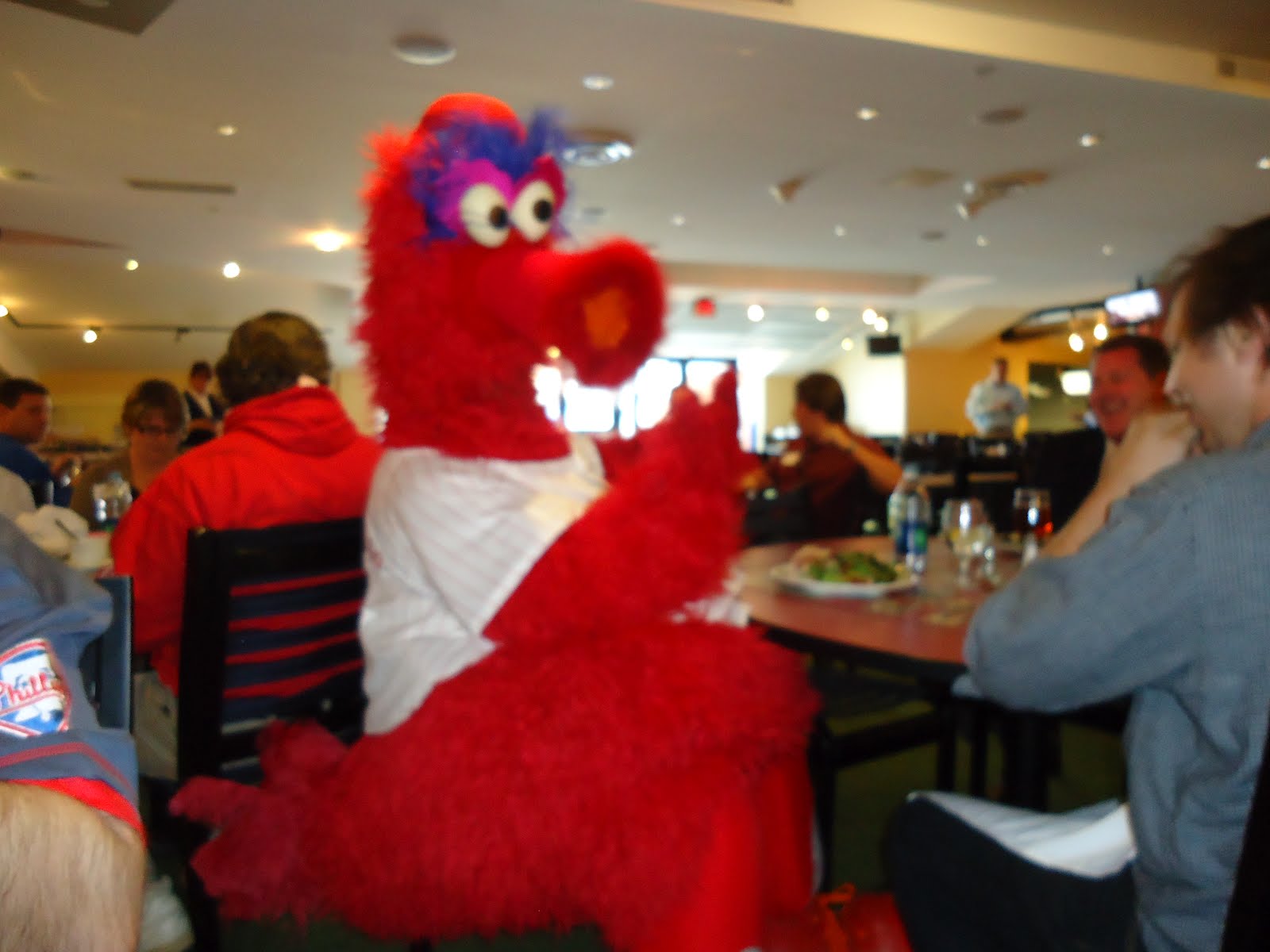
A lot of people don’t know this about me, but I absolutely love the Phillie Phanatic. I was naturally a huge fan of the loveable and hilarious green creature when I was a kid, but I never got to see him up close. That dream finally came true in 2009.

In the winter following the Phillies’ World Series title, the championship trophy was sent on a tour around the region so that fans could see it. At the time, I was a sports writer for the Gettysburg Times, and my editor was nice enough to assign me the story when the trophy made a stop in town that February. I obviously would have gone anyway, but this allowed me to get in for free and skip the line. It was also my first chance to cover an official event by the team I loved and had been supporting for nearly 20 years.

The cherry on top was getting my picture taken in front of the trophy, standing next to the Phanatic. He happily gave me a high five as I approached him for the photo. The sound of my hand hitting his…um…wing made a funny thud.

The Phanatic provided non-stop entertainment in that ballroom, of course. He stuck out his party-favor tongue for anyone who crossed his path, and the catering staff was so enamored by his antics that they all posed for a photo with him.

That was a magical afternoon, and I would get to have many more interactions with the Phanatic in the following years. Obviously, none of those held a candle to the first time.


Another Phillies personality I’ve gotten to meet multiple times is former relief pitcher and radio broadcaster, Larry Andersen. I received his autograph at a game in 1994, his last season as a player, and then 18 years later, he chose me to ask manager Charlie Manuel a question at a media luncheon. In 2013, I went to Fan Photo Day at Citizens Bank Park, where I basically met every member of the team, including the coaching and media staffs. I personally got a photo taken with Cole Hamels, and when ‘LA’ came by, I coyly asked him if he had a “Shallow Thought for the day,” like the late, great Harry Kalas used to do when they were broadcast partners in the late 1990s and early 2000s. Without missing a beat, he responded in his classic deadpan delivery, “We all know the speed of light, but what’s the speed of dark?”

I also had some fun with a Phillies player that day. When Delmon Young (remember when he was a Phillie??) made his way to me, I decided that I was going to flip the cliché home run request on its head. I told him I was sitting in the 400 section behind home plate and asked if he could hit a foul ball to me. He chuckled somewhat nervously and said, “Ok.” Sadly, Young was not able to fulfill my request. Oh well.


This last story is pretty short, but I know I’ll be telling it for years. Last year, I went to a Phillies game with some friends, and the one friend who secured the tickets managed to get us seats behind home plate only several rows up from the field. I took great delight in cheering and heckling louder than I ever had before. Another bonus about sitting that close is you might see a famous baseball face. A few innings into the game, I did a double-take when I realized that former, disgraced Phillies General Manager, Ruben Amaro, Jr., had taken a seat directly across the aisle. I believe at this point, he was a scout for the Mets. Over the next few innings, I worked up the nerve to say something to him, and when I got up to head for concessions, I extended my hand and thanked him emphatically for bringing Cliff Lee back to Philly in 2011. He accepted the handshake but gave me a bewildered look. I’m assuming he either thought I was being sarcastic or that I was drunk. My compliment may have been a tad in jest, but I was sincerely happy that he re-signed Cliff Lee a year after letting him walk. It was probably the only thing Amaro did right while he was GM.

Thursday, April 5, 2012

Manuel, Phillies ready to lift lid on season

The burning anticipation hung like a thick fog over the entire Diamond Club at Citizens Bank Park.

It was just 24 hours until the first pitch of Opening Day for the Philadelphia Phillies, but the team's television broadcasters and manager Charlie Manuel all said the same thing.

"We were ready two weeks ago."

A special event was held at the stadium's exclusive club for all the radio stations that broadcast Phillies games, including Gettysburg's own Fox Sports 1320, of which I was an honorary employee for two hours.

After a filling lunch of Italian hoagies, cheesesteaks and Tastycakes, the group was treated to a Q & A session, first with GM Ruben Amaro, Jr., and then Manuel and pitching coach Rich Dubee. These unique media members were the last who got to grill Amaro and Manuel about all the issues facing the team before the start of the regular season.

Amaro was his usual cryptic self, speaking in generalizations about the state of the team, and he looked quite flustered by the last few questions/comments from the crowd. One suggested that maybe Jimmy Rollins would stop swinging at the first pitch with the wise hitting presence of Jim Thome in the dugout. Amaro quickly snapped back, "You're not upset when Jimmy gets a hit on the first pitch."

Perhaps to distract us from the ongoing negotiations to sign Cole Hamels long-term and the unknown timetables for the return of Ryan Howard and Chase Utley, Amaro went in depth about the disgusting nature of Howard's recent infection around his surgically repaired Achilles tendon.

God knows why the GM would have his hands anywhere near the injured foot of one of his players, but the event's MC, Phillies play-by-play radio broadcaster Scott Franzke, made light of the situation by asking the audience, "Everyone ready for lunch?"

The mood was more relaxed when Dubee and Manuel took the stage, but even Manuel seemed a bit testy about the questions he's also been asked for the past six weeks.

Fans and reporters do have a valid cause for concern, especially considering we've all grown accustomed to the Phillies winning the NL East every year.

If you want to point the finger at what could snap that five-year streak, look no further than the offense. Lack of hitting has been the culprit for most of the Phillies' losses over the past two years, and the absence of more trophies on the shelf next to 2008. The only offensive additions the team made in the offseason were to its bench, so as a hitters' manager, Manuel will continue to field some tough questions as the season gets going.

Howard and Utley will be mere shadows of themselves after they return - I would say May for Utley and July for Howard - and a third of Philly's games will come against Atlanta and the much-improved clubs in Miami and Washington (Manuel's money is still on the Braves as their toughest competition in the division). The Phillies will still make the playoffs, but if they want the high seed a division title brings, Rollins will have to stay healthy the whole year, Shane Victorino and Hunter Pence will both have to hit above .300 and John Mayberry, Jr. will need to have a breakout year with 25-30 home runs.

Amidst all the negative predictions, Amaro and Manuel were positively gushing about Joe Savery, who was the 12th and final pitcher to be named to the Phillies' Opening Day roster. The team's first-round draft pick in 2007, Savery converted to hitting last year after serious control problems, but he magically rediscovered his hurling talents and made the team after a solid Spring Training (1-1, 3.48 ERA). With Jose Contreras opening the season on the Disabled List, Savery will get to prove himself out of the Phillies bullpen.

Pitching is the area that the Phightins' aren't worried about, so much so that color announcer Gary "Sarge" Matthews claimed during a Spring Training broadcast that he could take over for Dubee. His fellow broadcasters let the audience know that they will never let him live that one down.

With fiery closer Jonathan Papelbon now putting the finishing touches on the masterpieces of the three aces, we can excuse Sarge's impertinence. We've gotten used to it over the past five years.

I was selected to ask Manuel one final question before he and the rest of the team left for Pittsburgh, and I decided to go easy on him. I wanted to know which pitcher gets the most upset at him when he walks to the mound to take them out.

"I'd say Halladay, (Cliff) Lee and Vance Worley," he replied.

Phillies radio color man and former pitcher Larry Andersen immediately followed by asking Manuel in jest if he ever got scared taking Halladay - who will start Game 1 against the Pirates this afternoon - out of a game in the ninth inning.

Charlie gave the slightest of smiles and said, "If I ever got scared, I'd turn around, go into my office, take off my uniform and go home. You can't ever be scared to do that."

That answer reminded us all why Manuel is the winningest manager in Phillies history, and with him at the helm, there's no reason to look upon the 2012 season with anything but excitement.

Wednesday, February 1, 2012

PSWA dinner reveals inspiring sports heroes

note: This is another column of mine that ran in the Gettysburg Times about my experience at the PSWA dinner.

My body suddenly froze as I locked eyes on a face that looked as familiar as when the body attached to it donned a Philadelphia Phillies uniform.

His jet-black hair was well kept - likely aided by some gelling agent - with its usual part down the left side. Ruben Amaro, Jr. looked directly through my gaze without expression, the perfect poker face for any general manager.

As Amaro hung a right into the socializing area outside Ballroom C, my eyes grew wider as he was followed by Phillies manager Charlie Manuel and right fielder Hunter Pence. At that moment, I didn't know which items to shove in their faces, a baseball and pen, or my digital recorder.

Neither seemed appropriate, however. These men were baseball royalty, but I was surprised how much they appeared like regular guys without any mental reminders.

I snapped myself out of the trance and gave Charlie Manuel a pat on the back and a simple greeting; as if he was a friend I had just bumped into at a party. To my relief, he briefly spun his head around and returned the greeting with a smile. Good old Uncle Cholly.

There is sometimes a fine line between reporter and fan, and I frequently danced on both sides of it during the 108th Philadelphia Sports Writers Association Dinner Monday night at the Crowne Plaza Hotel in Cherry Hill, N.J. I gabbed with fellow sports writers while snagging a few John Hancocks from the head table.

The event was held to recognize Philadelphia-area athletes in all sports with achievement awards. Manuel received a special achievement honor for becoming the winningest manager in Phillies history this past season. Pence won the 2012 Good Guy Award for his immediate affinity with the team and fans when he was traded from the Houston Astros last July (further bolstered by his recent one-year, $10.4 million contract that avoided arbitration).

When Manuel began his acceptance speech, the only words I heard clearly through his West Virginia drawl was "nudist colony," which prompted the biggest laugh of the evening from the audience. His full opening line was, "I feel like a mosquito at a nudist colony," but he had to wait a good 15 seconds for the laughter to die down before he awkwardly delivered the punch line: "I don't know where to start."

Often the butt of a joke due to his 'not-so-good' diction, Manuel came across to the crowd the same way he did with me earlier, as a humble man who appreciated the job he was given as the Phillies' skipper.

As for Pence, the way he worked the crowd, you might have thought he actually grew up in Philadelphia (his speech revealed but a hint of Texas twang). His opening referred back to the acceptance speech given by Philadelphia University men's basketball coach Herb Magee, who playfully lamented that his granddaughters were more excited about getting their picture taken with the dashing Pence than seeing him receive the Living Legend Award.

In response, Pence quipped, "I just won the Good Guy Award so don't parade your granddaughters around me, please."

The Philly outfielder was also one of several honorees to mention the rousing speech given by Temple University head football coach Steve Addazio, whose rant of inspiration made every attendee in the ballroom feel like one of his players in the locker room on game day. When he was finished, no one questioned how the Owls won their first bowl game since 1979.

"Is my heart still pounding," Pence asked as he looked in Addazio's direction. "I don't know if you're still here or not, but I need you to speak to me before every game."

My recorder captured all of this humorous dialogue, but I shot an arrow through my professional credibility by yelling out Pence's name right before he approached the podium. Truth be told, he was the main reason I wanted to attend the dinner. From the moment he put on those red pinstripes, he has reminded us all of what a baseball player used to be before the stat crazes and steroids - pulling up those socks to his knees, choking up on the bat like the Mickey Morandini of old and slapping the lumber at the ball with odd precision.

My reporter sensibilities came back into focus when the PSWA honored the memories of boxer Joe Frazier and Penn State head football coach Joe Paterno.

As the chilling sounds of boxing's 10-bell salute filled the silence in the room, emotion overtook the bell's ringer, Frazier's daughter Jacqui Frazier-Lyde - a boxer in her own right, as well as a Municipal Court Judge. But like her father did so many times in his career, she finished what she started.

Paterno was honored with poignant words from former Penn State cornerback Adam Taliaferro, who played in just five games as a freshman before a spinal injury ended his career. After surgery, he was given only a three percent chance to walk again, but he defied the odds during an eight-month stay at the Magee Rehabilitation Hospital in Philadelphia. A frequent visitor kept his spirits high.

"Every week Coach Paterno came to visit me," he said. "It was a three-hour drive. He didn't have to do that. He was one of the most genuine, down-to-earth people I ever met. My career was over and he asked me every day what I wanted to do with my life. He got me internships and sent letters of recommendation. He wanted me to be successful after football."

A shining example of Paterno's Grand Experiment, Taliaferro is now a lawyer in Cherry Hill and was recently elected to the Gloucester County Board of Chosen Freeholders.

The Philly area was the site of another miracle recognized by the PSWA in its final award presentation. The association chose Anthony Robles as its 2012 Most Courageous Athlete. The Arizona State wrestler captured the NCAA Division I title at 125 pounds at the Wells Fargo Center last March, despite being born without a right leg.

"I never thought of it as a handicap," said Robles, who has become a motivational speaker since graduating and is working on a book about his life.

As Robles spoke, the real magic of this event washed over me. The association helped my realization by turning off all the lights except the one on the podium, making Pence, Manuel and Amaro disappear. Stories like Robles and Taliaferro are at the core of what it means to be a sports writer; teaching readers who are living in an increasingly cynical world about overcoming any obstacle to achieve success.

Though I returned to being a fan by the end of the dinner, Robles and Taliaferro were now the athletic giants who left me frozen in awe as they walked by.

Sunday, July 31, 2011

Shades of the past

"You want to be in a town where it's exciting and people are paying attention."

~Hunter Pence after being traded to Philadelphia

Anyone paying attention to the Phillies in their three-game sweep over the Pirates this weekend received wonderful reminders of 2009, even though Hunter Pence's arrival was a big call to the future.

In each game, a different member of the formally dangerous offense sparked the victory - Chase Utley on Friday, Ryan Howard on Saturday and Raul Ibanez in Sunday's thrilling 6-5, extra inning triumph.

Though his .247 batting average suggests otherwise, Ibanez has been a presence in the lineup. His two bombs on Sunday gave him 16 on the year, already matching last year's total with two months left to play, and his game-ending, RBI double gives him three of the Phillies' six walk-off hits this year. Take out the two weeks in late April when he failed to get a single hit, and Ibanez' average is .275. Sure, that's not eye-popping, but his production is a welcome surprise given his age of 39.

Ibanez also drove in 25 runs in July, which led the majors. In fact, the hottest month of the year was a good one for the Philly bats in general. They hit .272 and averaged 5.5 runs per game, while their 138 runs, 402 total bases and .789 team OPS (coming into Sunday) all led the National League.

Charlie Manuel is notorious for his placating remarks about how good the Phillies lineup will get "when the weather warms up," and they're proving him right. On the eve of a 10-game road trip, the hot-hitting Phillies go in with extra confidence. Pence now mans right field and the No. 5 hole, and Placido Polanco just returned. Don't be surprised if the flashbacks to the recent past continue.

Sunday, October 24, 2010

All Good Things...

Pat "The Bat" Burrell is headed back to the World Series, but unfortunately for the white-rally-towel twirlers, not as a member of the Phillies.

Brotherly love wasn't enough for the boys in red pinstripes as they saw their season end with a 3-2 loss in Game 6 of the NLCS to the San Francisco Giants, who needed to beat the San Diego Padres on the final day of the regular season just to make the playoffs.
Now the two teams that were expected to meet again in the World Series for the second straight year will both be watching from home. An offensive blackout led to the demise of the both the Phillies and the Yankees, though the writing was on the wall for Philadelphia.

Injuries took a heavy toll on the Phillie hitters for a significant part of the regular season. While the addition of Roy Oswalt led to a dramatic turnaround over the last two months and another NL East title, that same old magic that carried the team through the previous two postseasons was nowhere to be found. And playoff teams that boast some of the best pitching in baseball took a note from the Yankees on just how to handle such a dangerous lineup.

It was no surprise, then, that Ryan Howard was the strikeout victim who ended Philly's 2010 dreams.

Howard is now first or tied for first for the most strikeouts in two separate postseason series, and drove in nary a run from the clean-up spot this October. Since his infamous whiffing in the 2009 Fall Classic, the Big Piece has struck out in 30 of his 56 playoff at-bats. That means that in more than half his trips to the plate, the man who is paid $20 million per year to crush balls over the fence didn't even put the ball in play. Of the 26 times Howard managed knock the ball between the lines, only one left the yard.

Ironically, Howard was the only starter in the lineup to hit better than .300 in the postseason this year, though he was typically all alone on the basepahts. Raul Ibanez was a distant second with a .226 average. Carlos Ruiz, who had never hit below .262 in any previous postseason, was dead last at .192.

As Charlie Manuel explained, the Phillies were too concerned with working the count, rather than being selective. They stood and stared at too many fastballs down the middle of the plate, making it easier for pitchers to get them to chase at breaking balls that tailed out of the zone. Combined, Cincinnati and San Francisco held Philadelphia to 3.7 runs per game - compared to 4.6 in '08 and 5.5 last year - and not even the likes of Roy Halladay, Roy Oswalt and Cole Hamels can carry you to a championship with that kind of production.

The beleaguered Phillies pitching staff still consistently put the team in a position to win. Aside from Game 3, each one of Philadelphia's losses in the NLCS could have gone the other way. It was basically the Giants coming up with the big hits, and some would add Halladay not getting the start in Game 4. No one can predict what would've happened in that scenario, but as close as each game was, such decisions loom very large.

But the shadows cast on the end of this season will quickly fade, as the sun shines brightly on a new day for the Phillies in 2011. All three elements of H2O are returning, as well as the entire starting lineup, aside from the likely departing Jayson Werth. Should the corner outfielder follow in Burrell's footsteps and find his way back to the Fall Classic with another team, the Phillies hope that when he gets there, they will be staring him down from the opposing dugout.

Friday, October 22, 2010

Can Phillies complete comeback?

What Roy Halladay did Thursday night is not unprecedented.

Some fans remember well, and others would love to forget, Curt Schilling's gutsy performance in Game 6 of the 2004 ALCS. With the Boston Red Sox facing elimination, Schilling led them to victory while sutures struggled to hold together a ruptured tendon in his right ankle.

Admittedly, a strained groin is not the same as a bleeding ankle, but Halladay adjusted to the pain and the sinking fastball he was forced to abandon. After the Philadelphia Phillies took the lead in a crazy third inning, Halladay made it stand up as his team went on to win 4-2 and send the NLCS back to Citizens Bank Park.

The law of averages tells us that the Giants will win one of the next two games and advance to the World Series, and the way this series has gone for the Phillies, that's a good bet to make. The hitting just isn't there like it was in 2008 and '09, but then again, teams have a way of rallying around a wounded teammate. Boston did it in '04 and the New York Yankees seem to be doing it in the ALCS for Mark Teixeira.

Either way, this is turning out to be a thrilling postseason. It's the first time since 2004 that both LCS's have reached Game 6. And with both teams that were down 3-1 winning Game 5, it makes an improbable comeback in one of the series seem more likely.

How likely is it for the Fightin' Phils? Of the six times it's been done since the LCS went to the best-of-seven format in 1985, three have come in just the last seven years, and three of the six teams won the last two games on the road. The latter fact doesn't hurt or help the Phillies, but their success in the postseason centers around playing well in their own digs. Since 2008, Philadelphia boasts a 15-4 playoff record at home. That's the kind of clout the Texas Rangers wish they had right now.

Roy Oswalt and Cole Hamels (if it gets that far) will do their jobs, but the offense must do theirs. Manager Charlie Manuel can help that along - and atone for a plethora of bad choices in Game 4 - by putting Jimmy Rollins back in the leadoff spot for Game 6. He's proved that he's at least close to where he was before his latest injury setback. Since Game 2, he's 5-for-15, and he swiped second and third base in the seventh inning of last night's triumph. Shane Victorino, meanwhile, is clogging the top of the order with a measly three hits in the series.

If the Phillies continue hitting at their present .190 clip, their season will end at Citizens Bank Park. That hasn't happened yet in the postseason (their playoff runs in '07 and '09 ended on the road) and for a hostile fan base so used to seeing their team succeed in October, it won't be a pretty sight. It's in the Phillies' best interests and the well-being of Philadelphia to reward Halladay's effort, stun the Giants and punch their third straight ticket to the World Series.

Sunday, October 10, 2010

Reds get a lump of Cole

It wasn't that long ago when the Phillies experienced the hurt they just put on the Cincinnati Reds in the Division Series.

It was 2007 and a fairly young Philly team made a surprise trip to the postseason for the first time in more than a decade. Leading the way was experienced manager Charlie Manuel, who was in the third season of a job that finally paid the dividends the higher-ups were hoping for. Just as quickly as the Phillies realized their dream, it was snatched away by a three-game sweep.
Since then, Philadelphia has done nothing but win in the playoffs, and it showed an untested Cincinnati team and its veteran manager how it's done.

Twenty-six-year-old Cole Hamels locked up his team's third consecutive trip to the National League Championship Series with a pitching performance on Sunday that arguably exceeded any of his stellar starts during the 2008 postseason. He allowed just five hits and struck out nine in a 2-0 win. Hamels threw the second complete-game shutout for the "Big Three" in the series, proving that even if two of the three are dominating, the Phillies are still unbeatable.

Hamels often found himself on the wrong side of these kind of games during the regular season, but the October Phillies are a different breed from the first-half Phillies. They come up big when it matters the most. Shane Victorino made a game-saving grab, Chase Utley hit his 10th career postseason home run and Hamels took care of the rest.

The crafty left-hander said after the game that his overwhelming success at the hitter-friendly Great American Ballpark - he's now 7-0 there - could be partially attributed to that fact that it was the site of his first big league start back in 2006. The Reds have improved a great deal since then, but they ran into an even more refined Hamels. The perfection of his cut fastball in the latter half of this season added a new weapon to set up his deadly changeup, which had Cincinnait's right-handers hitters fooled all night.

As good as their pitching has been, the Phillies would be the first ones to admit that they're still not firing on all cylinders. Nearly half of their 13 runs scored over the three games were provided by the opposition. The shallow dimensions of Great American were barely enough to take Utley's homer, the first long ball of the postseason for Philadelphia. The team knows it can hit much better than this, and a better outing from Roy Oswalt also wouldn't hurt. His first playoff start in five years turned out like his first start as a Phillie, but he went 7-0 after July 30 so a better outing in the NLCS is very likely.

The players in Philly know to ignore all the great hype surrounding them, but thus far they're on track to prove the prognosticators correct. The Atlanta Braves and San Francisco Giants - two other teams that have returned to the playoffs after long absences - are in the midst of an uncomfortable battle, and whichever group advances, they know the road only gets harder against a dangerous Phillies team that's now won six of its last seven series on the big stage.

Monday, July 12, 2010

Why does the AL always win?

I've got some more Trek geek trivia for you, which compares to the National League's current plight. I noticed a long time ago, and it's probably noted on several Trekker blogs and message boards, that during the entire seven-year run of Next Generation, Geordi LaForge was the only regular who never won a poker game. Seven years without winning once - that sounds familiar...

Ah, the age-old question.

It may seem strange to categorize the question as age-old considering that the NL dominated the Midsummer Classic for the majority of its history. But I think the adjective fits in my case, since the AL turned the tables in 1988 when I was only six years old. In that time, the AL has gone 18-3-1 in the All-Star Game and is presently maintaining a 12-game winning streak (excluding the 7-7 tie in 2002).

I’m on a fool’s errand to try and find an answer to the AL’s success, but that has never stopped any of my previous endeavors. In my research I used a combination of my own observations and expounded upon the opinions I heard and read from various sources. As always, it’s up to my audience to decide whether or not my findings carry any weight.

The first thing I did was to limit my research to the past seven All-Star Games, since the ridiculous decision was made that the winner of the mid-July showcase would be rewarded home-field advantage in the World Series (a decision that hasn’t really hurt NL teams, which have won three of the last seven Fall Classics without home-field advantage). The All-Star Game shouldn’t affect anything during the regular season or playoffs, but it’s good to study the games that have actually mattered. Steroid use has also been on the decline since 2003.

With the parameters set up, I started searching for a pattern of dominance. I knew this would be no easy task, given the inherent randomness of one baseball game, let alone seven. There was also the fact that the AL had won each of the last four All-Star Games by just one run.

Luckily, I happened to catch an interview Bob Costas conducted with Jimmy Rollins and Ryan Howard. He asked them why they thought the AL kept winning, and they said the designated hitter gave the Junior Circuit all the advantage. That argument seemed pretty weak, but Costas led me down a more concrete path of reasoning when he pointed out that the Phillies offense struggled mightily against New York Yankee pitchers in the World Series. Howard particularly looked bad against a continuous string of breaking balls low and away.

It then dawned on me; why don’t NL pitchers throw Howard more off-speed junk? I’ve also read that AL pitchers in general throw more breaking balls, maybe because they don’t have to worry as much about small ball with the designated hitter. When you’re not throwing to poor-hitting pitchers or worrying as much about the bunt or hit-and-run, you don’t rely as much on the fastball. All major league hitters are looking for the fastball, so could the AL just be getting better pitches to hit from NL flame-throwers?

A general look at total baserunners and strikeouts over the last seven years turned up no patterns. The AL didn’t dominate either category.

As I continued my search, I read a theory online (with no numbers to back it up) that said the American League had better relief pitching in the All-Star Game. I immediately tracked down those numbers and on the surface, they appeared to support the claim.

In the past seven All-Star Games, AL relievers have posted a 3.91 ERA, compared to the NL’s 5.49. The disparity grows even more in the four one-run contests, three of which were decided in the last two innings. Since 2006, AL relievers have allowed just two earned runs in 15 innings, while striking out 16. In that same stretch, NL relievers have surrendered eight earned runs on 16 hits with just eight strikeouts.

This might explain the NL’s tendency to lean on starters much later in the game. The AL always seems to come up with the big hit off the guys whose job it is to shut down late rallies.

However, this explanation is hurt quite a bit by the fact that AL relievers have also walked eight batters in the past seven Midsummer Classics, compared to just three by the NL. The last thing you want to see late in a tight contest is a bunch of free passes. The AL is simply picking up the key outs, while the NL keeps getting hit.

In the end, this all seems to come down to a lot of luck. The AL stars keep calling heads and at the end of each game, George Washington’s profile continues to shine up at them.

The American League does have one clear advantage in relief pitching, though. Of the eight saves it has recorded since 1997, Mariano Rivera has four of them. Arguably the best relief pitcher in baseball history, Rivera has yet to allow an earned run in the All-Star Game.

The NL won’t have to worry about Rivera tomorrow due to his opting out, but his mentioning leads very well into my only other explanation: the AL always wins because the Yankees and the Red Sox are the two best teams in baseball. No other teams have enjoyed such a prominent presence in the Midsummer Classic. Since 2000, no fewer than a combined seven players from the two squads have been selected as representatives of the AL elite, and the pair also made up more than half of the starting lineups in ’02, ’05 and ’08.

Not only did New York and Boston feature some of the best pitchers of the last decade, but their hitters are notorious for working the count and getting on base. Stability breeds success and with so many Yankees and Red Sox taking the field every year, not to mention the pesky Ichiro cementing himself at the top of the lineup, it’s a winning formula. Aside from Albert Pujols, the NL can’t maintain that kind of consistency.

Whatever help the NL needs to break the pattern, it won’t get it from second-year manager Charlie Manuel. The Phillies skipper, in his infinite wisdom, decided to fill his roster with Atlanta utility infielder Omar Infante and Houston Astros centerfielder Michael Bourn (.255 batting average, 66 strikeouts and .661 OPS). Manuel apparently doesn’t pay attention to anyone in his league outside of former Phillies and players from his own division. Two guys who have no business making an All-Star Team, and probably never will again, were chosen outright, while the Reds’ Joey Votto – the best hitter in the NL right now – needed to squeeze in with the fans’ final vote. Votto is a guy who could easily come up with a couple of big hits, and he might not even leave the dugout.

This isn’t the first time NL managers have made poor decisions in the All-Star Game. King Albert Pujols was kept away from his batting box throne in the ’07 Classic by his own manager, while the vastly inferior Aaron Rowand (even in his career year with the Phillies) was given a second at-bat and flew out with the bases loaded to end the game.

The odds don’t seem to be in the NL’s favor with all of these mitigating factors, but if the closeness of the past four games is any indicator, the coin could still fall the Senior Circuit’s way by the time the last out is made tomorrow in Anaheim.

Unfortunately, I see the gap widening and Washington’s face shining brighter than ever. The AL will take this one by a final of 6-3.

Tuesday, June 22, 2010

Take the hint, Raul


(Roundtable host to Bob Feller): “In 1940, you threw the only no-hitter on Opening Day in major league history. What do you remember, or what can you tell us about that game?”

Feller: “It was cold as Hell.”


The 91-year-old Hall of Famer then elaborated on his unique feat, saying how happy he was to accomplish it in front of his teammates, fans and family.

Family was the recurring theme of the Father's Day Hall of Fame Classic Weekend in Cooperstown. The nostalgia was as thick as the summer heat, and my dad and I soaked it all in. The Baseball Hall of Fame was easily in the top five of the most incredible places I've ever been to in my short lifetime. As we walked around, my dad and I quickly realized that anyone who wasn't a baseball fan in this town was automatically an outsider. We expected that, but the feeling was still a surprise because it's usually the exact opposite. It was almost like coming home.

I would argue that the gigantic role that baseball has played in his life has kept 'Rapid Robert' going all of these years. All of the great memories and community feel of the sport have kept Feller young. Being surrounded by thousands of other devoted fans (yes, even the Yankee supporters) made us all feel like kids again, too. Feller and the other six Hall of Famers in attendance during the weekend jumped at the chance to recapture that feeling of innocence.

Feller conveniently leads me into my next topic, as tonight Jamie Moyer tied the former Cleveland Indians hurler nearly twice his age on the all-time wins list. He notched his 266th victory with yet another stellar showing on the hill against none other than Feller's old ballclub. The tame Tribe hitters were clueless against Moyer's slow deception, as they managed just two hits off him through eight innings.

Of course, one of those two hits was a moon shot by Russell Branyan to tie Moyer with another Phillie, Robin Roberts, for the most home runs allowed all time at 505. What's even more interesting is assuming Jamie plays out the remainder of his three-year contract as a starter and retires after the 2011 season, he might finish his career surrendering 548 dongs, which would match Mike Schmidt's Phillies-leading career total. It's quite a dubious honor, but obviously chalked up to Moyer's durability in the game, and it won't hurt his Hall of Fame eligibility.

One player who did hurt his own standing was Greg 'fallen-from-pinch-hitting-grace' Dobbs. As the Phils re-activated Jimmy Rollins from the DL, they designated Dobbs for assignment. Philly also ended the second brief, failed experiment with Scott Mathieson, recalling Mike Zagurski in what has to be an attempt to help the bullpen recover from one its worst meltdowns in recent memory against the Twins on Saturday.

It says something about the state of bench when you need to subtract a guy to make it better, but Dobbs has quickly turned from Mr. Dependable into Mr. Expendable. It's a sad result as Dobbs was such an integral component to the postseason-bound teams of 2007 and '08. Before I fully understood the dynamics of the situation, I was actually surprised when Jayson Werth started getting more playing time in the latter half of '08 than Dobbs, who was a better hitter. That is clearly not the case anymore.

The team is presently not making any headway with closing the gap in the division. The All-Star Break and the Trade Deadline are quickly approaching, so other major personnel changes may take place if the Phillies remain on their present course of mediocrity.

Raul Ibanez, take this as your final warning.

The 38-year-old Phillies left fielder hasn't been the player they expected him to be for a year now. He's not seeing the ball well, which was even a fact during last season as a whole when he posted the worst strikeout/at-bat (1/4.2) and ground out/fly out (1.27) ratios of his career.

Ibanez has only managed brief glimpses of his former self in 2010. The latest occurred earlier this month when he went 8-for-20 over five games against the Marlins and Red Sox, but he has returned to his usual output, hitting just 5-for-22 (.227) since. His overall batting average hasn't risen above .267 at any point this season, and his power is virtually non-existent.

I don't know how many more times I can hear Charlie Manuel say that Ibanez will work his way out of this funk. He just might, but we've been waiting for a full season now. Given a healthy number of at-bats, Ben Francisco could provide the Phillies with so much more at the plate and in the field. I'd give Ibanez another week or two at most, and then at the very least bench him for a few games. This lineup can't afford a black hole in the No. 6 spot any longer.

Tonight's win was good, and J-Roll's return was even better. Despite all the griping and negativity, the boys' ride through Interleague Play has turned out a little better than I feared. The toughest part of it is over, so it's time to finish strong. Simply summon your inner-Feller.